Try Student Engagement Strategies That Work Best in an AI-Accelerated World

How to cultivate durable human skills in a landscape impacted by AI

In the age of AI, the most effective student engagement strategies build purpose, agency, and durable human skills. In The Disengaged Teen, Rebecca Winthrop and Jenny Anderson introduced the Four Modes of Engagement—Resister, Passenger, Achiever, and Explorer—to explain why students disengage and how educators can support deeper learning.

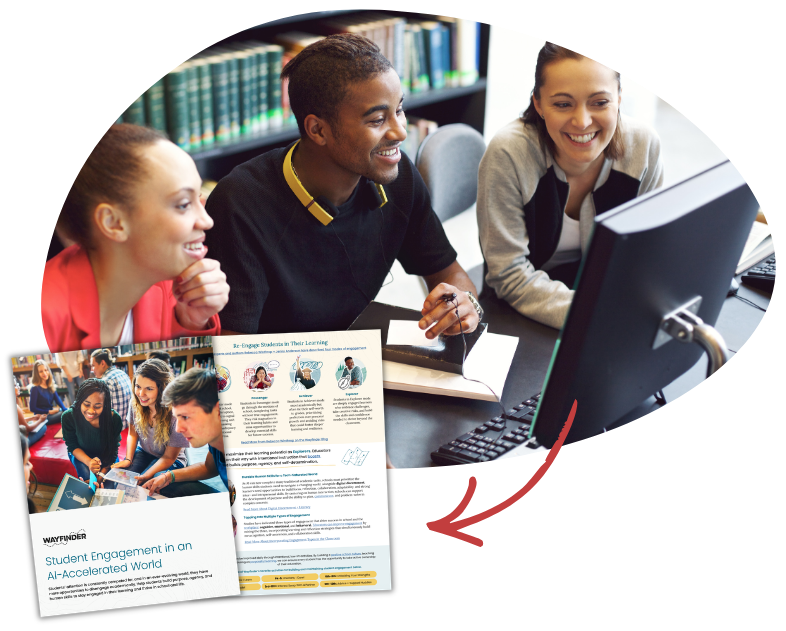
Wayfinder’s Student Engagement Strategies in the Age of AI Guide builds on this research by offering practical tools for school and district leaders, highlighting essential human skills such as focus, reflection, collaboration, adaptability, and digital discernment while strengthening cognitive, emotional, and behavioral engagement.

Get the Student Engagement Strategies Guide to equip your schools with practical strategies that help students become more motivated, confident, and deeply engaged learners, ready to thrive in a tech-saturated world.

Discover how to cultivate durable human skills in schools and districts impacted by AI and technology.

What Are the Four Modes of Engagement?

Today’s students are growing up in a world where AI can instantly write essays and solve problems—but it can’t replace their drive to learn and grow. In The Disengaged Teen, Rebecca Winthrop and Jenny Anderson describe four modes of student engagement that help educators understand what drives students to participate, persist, and thrive:

  • Resistor Mode: Students actively avoid or disrupt schoolwork due to frustration or disconnection.
  • Passenger Mode: Students comply but are disengaged, often coasting through without motivation.
  • Achiever Mode: Students focus on perfect outcomes but may lack deep curiosity or joy in learning.
  • Explorer Mode: Students are intrinsically motivated, proactive, and deeply invested in learning.

Learn more about this and Rebecca Winthrop on the Wayfinder Blog.